Overview
Entities in GlideRail are constantly moving, and will not stop accelerating unless they run into an obstacle. The physics behind their flight revolves around their base stats and ability to glide.
Stats
All entities move corresponding to these given stats. Most of these stats remain uniform between entities and are modified with multiplier values.
- Base Acceleration: How quickly an entity normally moves from 0 to their base velocity cap.
- Glide Acceleration: The maximum acceleration an entity can have. Occurs while gliding.
- Determined by Base Acceleration * Jet Multiplier.
- Drag: How quickly an entity can change their movement vector when turning. 0 is slippery while 1 is no slip. Does not (or at least, should not) affect base velocity or acceleration.
- Rotation Speed: How quickly an entity can turn themselves. Rotation speed is ease-in.
- Base Velocity Cap: The velocity an entity will normally accelerate to.
- Terminal Velocity Cap: The maximum velocity an entity can be in before losing control.
- Determined by Base Velocity Cap * Jet Multiplier.
- Jet Multiplier: How much Acceleration and Velocity are impacted by the number of Jets a Glider has. Entities with no visible Jets can still have a Jet multiplier.
- Base is 1.75x (1 Jet). Any additional Jets beyond 1 increase the multiplier by +0.75x.
- Some entities may not have uniform Jet scaling (i.e. Swarm growth). Jet multiplier is a float value, and thus can be increased non uniformly depending on its use case.
- Can Glide: A Boolean that determines if an entity is capable of using the glide mechanic. All gliders have this enabled, while some enemies do not.
- Any entity that cannot glide will have a Jet multiplier of 1x
Gliding
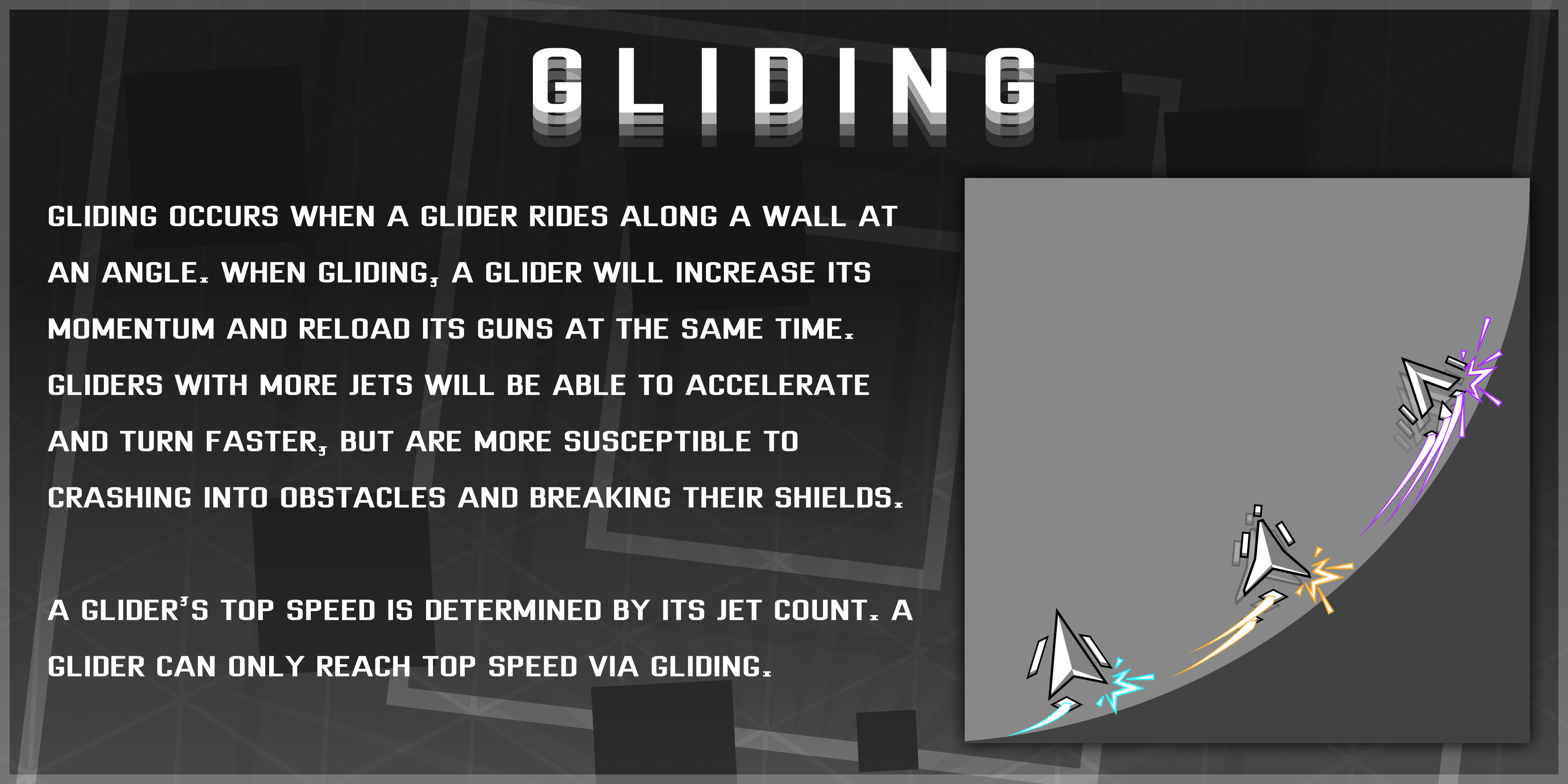
"Gliding occurs when a Glider rides along a wall at an angle. When gliding, a Glider will increase its momentum and reload its guns at the same time. Gliders with more Jets will be able to accelerate and turn faster, but are more susceptible to crashing into obstacles and breaking their shields."
" A Glider's top speed is determined by its Jet count. A Glider can only reach top speeds via gliding."
Entities capable of gliding can do so when they have their back angled to the wall (~120° cone radius behind the entity). When doing so, their maximum acceleration and terminal velocity increase, allowing them to maintain a higher speed. When an entity ends its glide, it will retain any speed it has over its soft cap until it returns to under the cap by any means, at which the regular velocity rules apply. Velocity does not naturally decay if the entity does not change its momentum vector
The acceleration / thrust applied to said glide varies depending on the distance the entity is from the wall or obstacle, with the Jet multiplier increasing exponentially the closer they are from the object they are gliding along. The Jet multiplier cannot exceed 5x
Example: A Glider with 1 jet has a base Jet multiplier of 1.75x at a distance of 1u (assuming 1u is the threshold gliding begins). Once under 1u, that multiplier begins increasing towards 5x.
By technicality, gliding is not a separate mechanic beyond increasing the top speed and thrust of the entity that is capable of gliding, it is just the term that this mechanic is referred as.